This story was originally published by Healthbeat Atlanta. Sign up for their public health newsletters at healthbeat.org/newsletters
Researchers in the South want people to know about an invasive ant species whose painful sting can cause fatal anaphylaxis in some people – and disrupt local ecologies as well.
Asian needle ants are not widely known and often meander outdoors individually, so it’s easy to miss them and get stung. As temperatures grow warmer in the spring, the ants become more active and people spend more time outside.
Dan Suiter, an entomologist with the University of Georgia’s extension service, received calls from three people in 2024 reporting being stung by Asian needle ants and requiring hospitalization for anaphylaxis, an allergic reaction that can be fatal.
Suiter said he wants to make sure people know about the Asian needle ant so they can avoid stings. Since he began putting out press alerts over the past few years, he’s received many more reports from people who were stung and needed serious medical treatment.
The species, discovered in Decatur, Georgia about a century ago, likely arrived in the United States through international trade.
The ant has been reported in more than 20 states east of the Mississippi River, from Florida to Wisconsin, according to data from the Global Ant Biodiversity Informatics project at the University of Hong Kong.
One study published last year found the ants thriving in a community mulch pile in Watkinsville, Georgia. Gardeners taking mulch from the pile could be contributing to the ant’s local spread, the authors wrote.
The species has a 100-year head start on researchers, and they lack good historical data as to how the ant has spread in the United States, said Christopher Hayes, an entomologist at North Carolina State University.

How invasive ants can affect the environment
As with other invasive species – like kudzu – it’s too embedded in the environment to successfully remove it, Hayes said.
In the Southeast, fire ants and Joro spiders are well-known invasive species.
Scientists are seeking to better understand the Asian needle ant: where it is, its habitat, and its environmental impact. That’s important, Hayes said, because the ant can harm ecological systems.
“On a daily basis, you have these multiple species that they’re always competing with one another,” Suiter said. Asian needle ants “out-compete” other ant species for food, driving those species to “local extinction.”
That’s a problem because those species are often responsible for seed dispersal that allows native plant species to reproduce, he said.
Hayes said he would like to figure out how to preserve native species and mitigate the Asian needle ant’s environmental impact.
Painful sting can prompt anaphylaxis, phantom pain
Allergic reactions to stings by honeybees, wasps, and ants account for up to 43% of anaphylaxis cases and about 20% anaphylaxis-related fatalities. That makes them an important, if sometimes underrecognized, public health issue, according to a 2022 study.
Suiter said people who are allergic to bees and wasps and those who carry EpiPens should know what the Asian needle ant looks like so they can avoid a potentially serious allergic reaction.
As temperatures warm and summers grow longer, Hayes said, the Asian needle ant will have longer active seasons. While the ants typically “hunker down” over the winter, they become more active in warmer weather, meaning people will have more chances of being exposed to them.
The ants don’t come indoors, instead preferring moist environments, like downed logs, Suiter said.
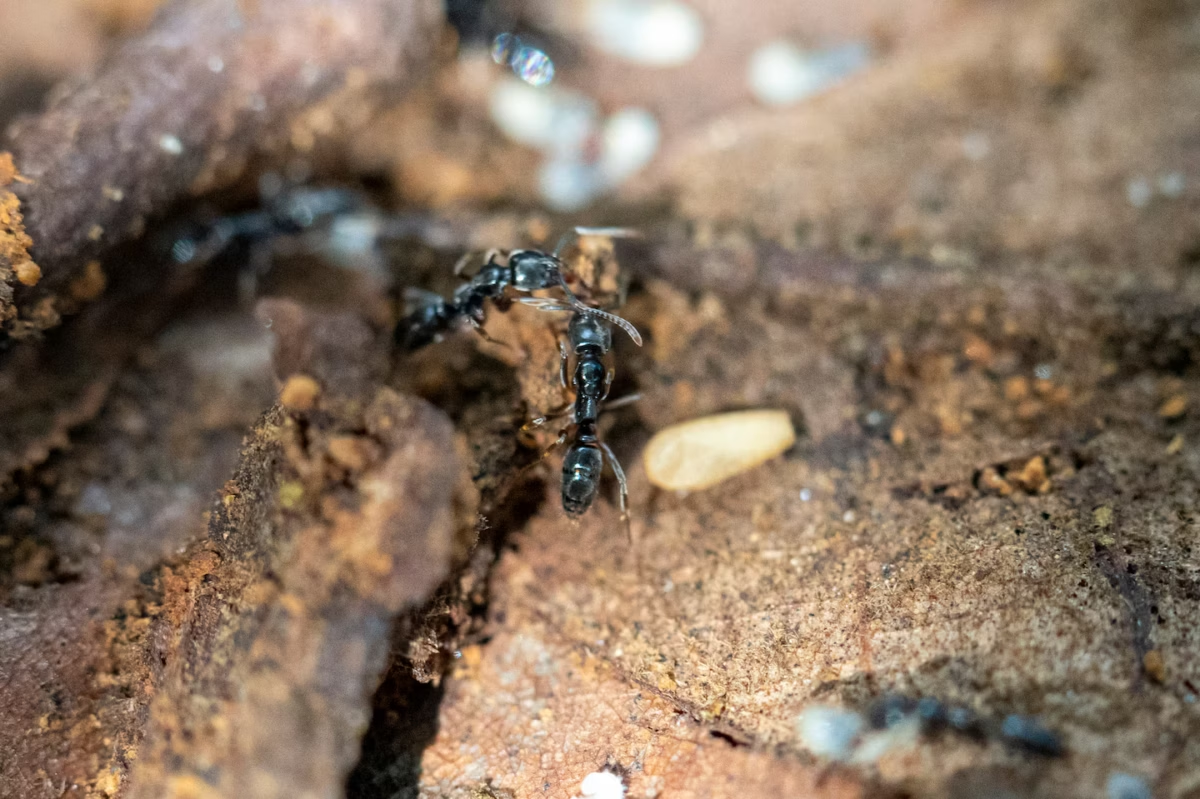
The ants, whose scientific name is Brachyponera chinensis, are brownish, measure 3/16-inch long, and often live in logs and leaf litter and under rocks and stones.
“One of the ways to minimize the numbers of needle ants in your yard would be simply to clean up all that,” Suiter said.
Asian needle ants are less aggressive than fire ants, Hayes said. They are “stealthier” and more likely to be hidden in piles of wood than the fire ant mounds that Southerners are used to seeing.
And while fire ants are more likely to come pouring out of a mound and bite people multiple times, Asian needle ants will “meander around on your arms” or other body parts until they get squeezed, such as in a gardener’s glove, prompting them to bite, Hayes said.
In contrast to most other ant species that form long trails, Asian needle ants tend to go it alone.
“When you see them in your yard or on the concrete, they’re just kind of meandering around as a single ant, and they don’t really garner your attention” the way ants in long trails might, Suiter said.

“With the Asian needle ant, their rate of triggering anaphylaxis from a single sting is much higher than the rate of a fire ant individual sting triggering anaphylaxis,” Hayes said. “The sting of an Asian needle ant is more dangerous on the individual ant level.”
Healthbeat is a nonprofit news platform reporting on public health from Civic News Company and KFF Health News. For this piece, The Lens added Louisiana-specific reporting.
Republish This Story
You may republish this story under our republishing guidelines. Please credit the reporter and The Lens, link to the original story, and respect any image restrictions shown below.
Images are not included in the republishable copy.
Republish This Story
You may republish this story under our republishing guidelines. Please credit the reporter and The Lens, link to the original story, and respect any image restrictions shown below.
Images are not included in the republishable copy.
License: Creative Commons Attribution-NonCommercial-NoDerivatives 4.0 International