Inisha London had her son during her senior year at Walter L. Cohen High School in 1995. She loved school so much that, even when she was in her final weeks of pregnancy, she kept going to classes “all the way up until.”
“School was fun,” London said, remembering how her teachers let her eat in class because she was pregnant. “I didn’t need to make the excuse and say, ‘I’m sick. I don’t feel good, I gotta go home,’ because it was fun.”

On Sept. 19, three decades after her graduation from Cohen, London sat in a folding chair under a white tent in Audubon Park, wearing a football jersey that reads “Cohen Hornets.” She was decked out in the school’s signature green and white from head to toe, including a customized fanny pack and socks.
London and hundreds of other Green Hornets came from across town and across the region to attend the school’s annual alumni picnic. Some sat in folding chairs under the shade of tents and trees; others stood over grills smoking sausages and flipping burgers. Everyone dressed in green and white.
Walter L. Cohen High School first opened Uptown in 1949, becoming the fifth public high school for Black students in New Orleans. It was named after Walter L. Cohen, a free man of color who was born in New Orleans in 1860 to Black and Jewish parents.
Like other local legacy schools, the Cohen alumni picnic has switched from class-specific reunions to all-school events. This summer’s picnic hosted graduates from the classes of 1953 through 2026, In some ways, it felt like the Hornets had taken over New Orleans. Clubs in the neighborhood hung green balloons and banners. The Hibernia tower in the Central Business District was lit green for the weekend.
The alumni picnic came at a time of high tension across the city for smaller legacy high schools like Cohen that might soon be vulnerable to closure, as the Orleans Parish School Board and NOLA Public Schools grapple with decreases in enrollment. School Board discussions about these realities and a charter switch for L.B. Landry on the West Bank have led to wild rumors about mergers and closures, mostly focused on high schools with fewer students, including Cohen.
Teachers who recognized students’ potential – and struggles
Growing up in the 12th Ward, Travis Hurel attended Cohen in the footsteps of his older brother and both their parents. Hurel played in the band — “everything except the woodwinds,” he said — including two years as a section leader before he graduated in 1996. Cohen’s tight-knit community and reputation as a legacy school Uptown gave it a family feeling, Hurel said.
“You would wake up so early just to get to school because you knew who was going to be at school,” he said, smiling. “You knew, ‘Ooh, it’s going to be fun today.’”
At Cohen, teachers taught much more than algebra and The Great Gatsby. They were also coaches and mentors who encouraged students to express themselves and went out of their way to help those who struggled, said Herman Smith, of the class of ‘75, who found himself struggling to balance academics with extracurriculars during his senior year.
He was a track runner — nicknamed “Crazy Legs” for his speed — and also was interested in art. As he painted on a mural inside the school and ran track, his grades started to slip. His teacher noticed.

“That was very interesting, to have somebody look at you and see something that a lot of people didn’t see,” Smith said. “She took me up under her wing, she tutored me and things worked out.”
That supportive philosophy remained at Cohen two decades later, said Gerard “Bo” Dollis Jr., a Cohen grad from the class of ‘99, who’s best known now as big chief of the Wild Magnolias, a Black masking Indian tribe. Though Dollis Jr. remembered being “horrible” at math, he also remembered teachers singing a song or cracking a joke in ways that drew him and his classmates in, showing them that school was a safe space for them, he said.

“Cohen back then, it was a bunch of kids that wanted to be hard and weren’t really trying to learn,” said Dollis Jr. But the teachers were clear: they wanted their students to learn.
Over the years, Cohen helped shape students like movie director Tyler Perry; Civil Rights leaders like Don Hubbard, class of ’58, a leader of New Orleans Chapter of the Congress of Racial Equality (CORE); Bob Tucker, class of ’59, who integrated the offices of City Hall in 1970 when he was hired as executive assistant to Mayor Moon Landrieu; flutist Richard Harrison, class of ’53, one of the first Black musicians to secure a permanent, full-section position in the New Orleans Symphony; and Bernette Johnson, the first Black justice on the Louisiana Supreme Court, who was valedictorian of the class of ’60.
“A lot of people that made a difference in New Orleans went to Cohen,” Dollis said. “I really think it’s because the teachers understood the kids.”
The school is also well-known for its generations of talented musicians, particularly the band that performed on the sidelines of football games and in Mardi Gras parades. Many Green Hornets have become fixtures of the city’s music scene, including Big Freedia, Soulja Slim, Aaron Neville, Huey “Piano” Smith, and DJ Jubilee (whom classmates knew as Jerome Temple).
Cohen’s band was among the best parts of going to school there, said Gregg Stafford, a trumpeter and jazz teacher who attended Cohen in the late 1960s and early ‘70s learned the foundations of music theory from his teachers there. Stafford has led the Young Tuxedo Brass Band for more than 30 years, and co-founded the Black Men of Labor, a civic organization fostering brass bands. The school was “very much respected,” Stafford said.
“Everything was just lovely at Cohen,” he said.

Closure concerns
In late August, the Orleans Parish School Board passed a district optimization policy that would require the superintendent to create a plan to downsize the district if less than 75% of schools are close to meeting their enrollment targets, or if more than half of schools enroll fewer than 675 students.
The policy does not require the superintendent to propose closing schools. But low enrollment has historically been a reason for school closures or mergers in New Orleans.

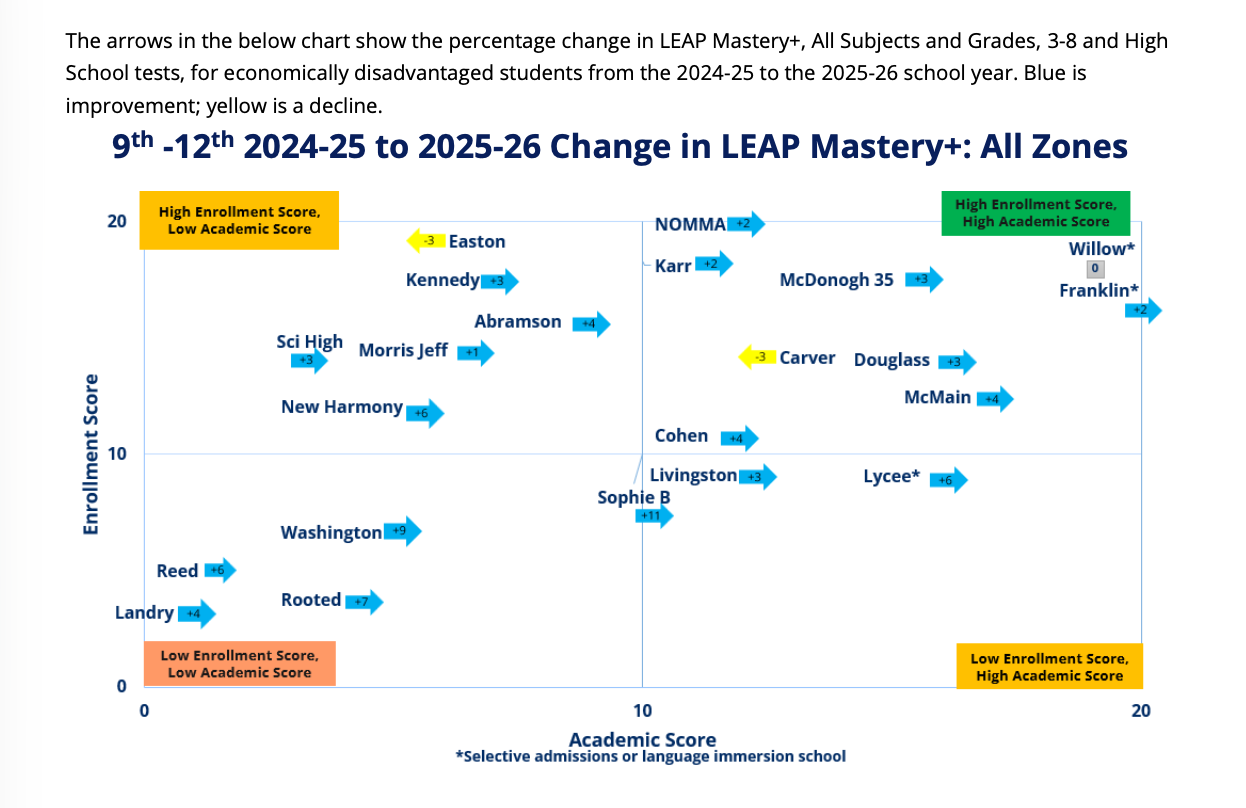
that represents high growth in enrollment scores and high growth in academic scores.
In addition to the new optimization policy, nine schools have charters up for renewal this year, meaning that the district must decide whether to renew those charters or close the schools.
In at least one case, a charter operator has forfeited its charter for a school — L.B. Landry High School — and the district must decide if it wants to find another operator to run Landry. Different schools’ charters are up for renewal each year, and the season is typically a fraught one for alumni networks; this year, some groups are even more frantic in the wake of the school board’s policy.
The school board discussion sparked concern for some Cohen alumni, and a letter sounding the alarm about potential school closures began circulating in some alumni Facebook groups. The Cohen alumni association even started a petition on change.org to advocate against closing the school.
“While no specific school was named, this public statement makes it clear that significant changes are ahead and that Walter L. Cohen’s future may be at risk,” the letter states.
There are no plans to close Cohen, said Read Irvin, a spokesperson for Collegiate Academies, the charter network that manages Cohen and three other New Orleans high schools.
“We are actively planning for Cohen’s continued expansion and success, including recruiting students for the Class of 2031 to enroll next fall,” Irvin wrote in a statement to The Lens. “Our focus is on continuing the progress underway and preparing our scholars for success in college, careers, and beyond.”

Herman and Sylvia Smith, both Cohen class of ’75;
Domicka Coleman, class of ’96, sets up a class banner for the picnic.
Class of ’84 (left to right) Gregory Lewis, Terry Kendrick and Debbie Lee. (Photos by Vivi Smilgius / The Lens)
Many legacy schools in New Orleans closed or merged in the post-Katrina era of the city’s schools. Cohen itself nearly merged with Booker T. Washington High School in 2015. This fall, legacy high school Sarah T. Reed put its name on the former Edward Livingston High School building after a merger in the East while Frederick A. Douglass High School moved in with John F. Kennedy, as the two legacy schools merged.
Cohen struggled with plummeting enrollment and a low performance score during the 2010s, but began to improve after its charter was transferred to Collegiate Academies in 2022, which in August 2023 moved into the school’s brand-new building at 3575 Dryades St.
Since 20222, the school’s rating has since improved from an “F” to a “C,” and enrollment has nearly tripled, bouncing back from pandemic-era lows. But it remains one of the smaller Uptown schools, enrolling 442 students last school year compared to 815 at The Willow High School, 723 at Eleanor McMain Secondary School.
The district still has several months to find out whether it will need to close or merge schools, but because of Cohen’s smaller student body, it’s been included in recent closure-merger rumors, alongside Booker T. Washington, which has 538 students, and Sophie B. Wright, which has 461.
In the past two school years, Cohen has made significant gains in students’ performance on standardized tests, with an additional 4% of students scoring in the highest category of LEAP exams, according to an analysis by New Schools for New Orleans.
Ester Brumfield, a Cohen alum from the class of ’90, said the alumni network has no clear information about a potential closure. She wants alumni to be included in discussions about Cohen’s future, like they have in past discussions about Cohen closing or merging.
“This is not the first time a conversation of this magnitude has happened,” Brumfield said.
What’s in a name
Walter L. Cohen became a successful businessman and politician, leading the Louisiana Republican Party for nearly 40 years. He famously said that, as a Catholic man with a Black mother and a Jewish father, he was “everything the Ku Klux Klan abominates.”
Cohen alums emphasized that they want the school to retain its historic name, even after the school’s charter was transferred several years ago. For them, the name reflects both the school’s long history and its importance for teens growing up in Uptown, particularly pre-Katrina, when neighborhood schools were the norm. Alumni have long seen the Cohen name as both a reflection of their neighborhoods and family members.
“There’s so many graduates of Walter L. Cohen who are doing so much in the community that gives New Orleans a whole lot of stability,” said Dow Edwards, a Cohen alum from the class of ’79.

Edwards has watched his alma mater struggle to re-build enrollment during an unstable era. After Hurricane Katrina, Cohen was run by a few different charter operators, classes were held in “swing spaces” in other schools while the building was demolished and rebuilt, and its students no longer came solely from the surrounding Uptown neighborhood.
“I think they really messed up after Katrina with taking away the neighborhood schools,” he said. “It kind of destroyed the fabric of what really held a lot of prideful moments and a lot of pride for people throughout the city.”
In reflecting on his time at Cohen, Edwards recognized the power of the school’s name. It’s important, he said, for Black children in New Orleans to have the experience of attending a school “named after a Black man, that can push and propel them on.”

After Edwards graduated, he had a football scholarship in Oklahoma and a brief stint playing football for the New England Patriots before serving in the US Army’s 82nd Airborne Division. He later worked in insurance and went into the legal field, working as a lawyer while masking as a Black masking Indian, first through the Mohawk Hunter tribe and now through his own tribe, as chief of the Timbuktu Warriors.
Edwards said he doesn’t know what’s next for Cohen. He recognizes that it could be threatened as legacy schools in New Orleans close.
He’d feel sad if it did, he said. “It would be tragic,” he said, “if they allowed another entity to come into that space and name it anything else.”