Dressed in vibrant satin with gloves and socks to match, carrying boa-wrapped umbrellas, whiskey flasks tucked neatly in their bras, and cigars hanging loosely in their mouths. Flamboyant in their presentation, with smiles that invite you to dance—and dance with you they will, if you get their attention by standing on the sideline.
This Black masking tradition, Babydolling, was born in segregation and raised in revolution in the early 20th century in one of the most notorious neighborhoods of New Orleans.
Black Storyville, or the Battlefield as it was called, was known for violence, vice, and good times. Jazz clubs, sporting houses, and gambling dens were the economic drivers for this area. The women who lived in this area did not have to seek independence; it was demanded of them.
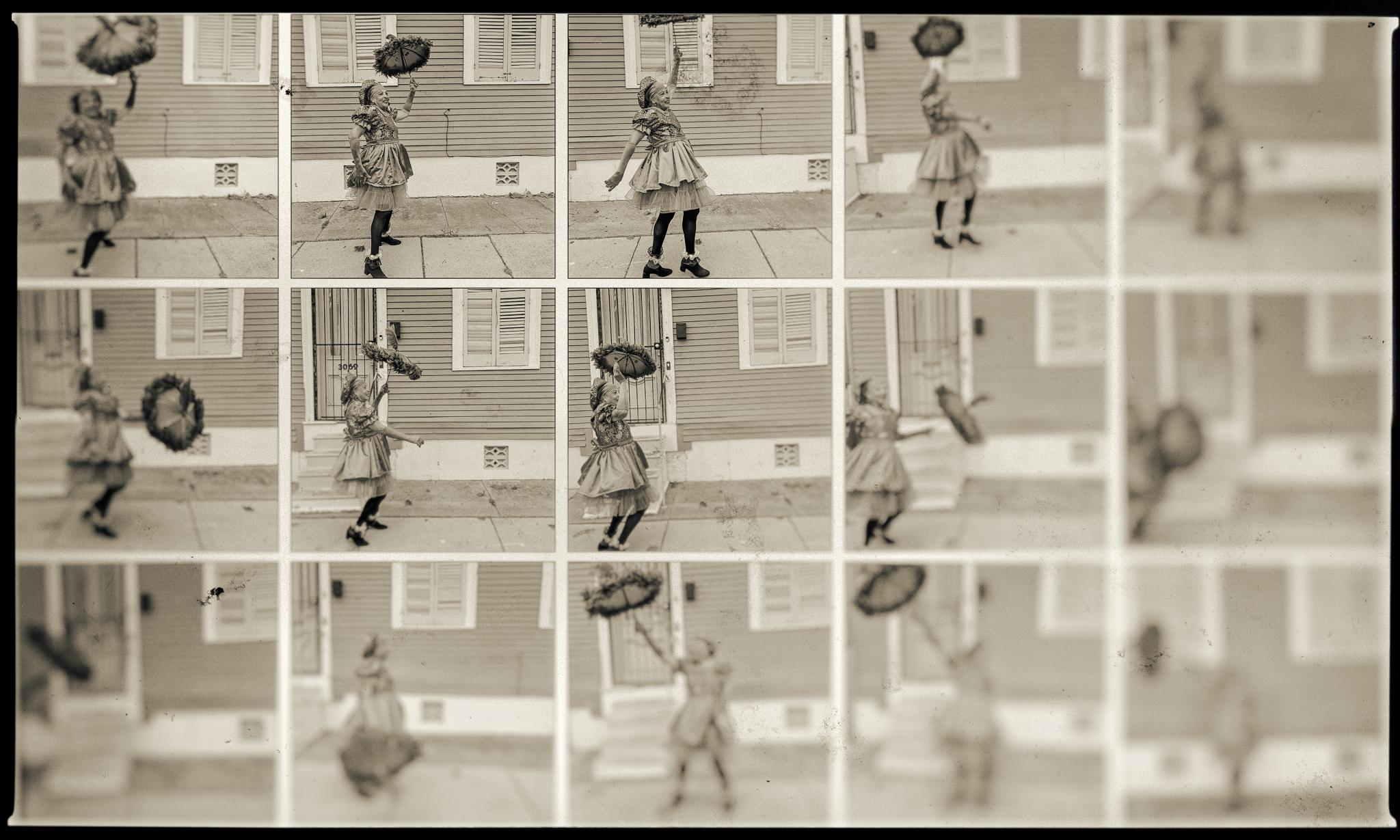
These dismissed, devalued, and disregarded women chose to boldly dare the world to see them as they saw themselves: valued, beautiful, and capable of holding a place in Carnival traditions.
This expression of Black women’s independence has lasted for over 100 years. Twenty years ago, when the nightmare of Hurricane Katrina was upon us and we were spread out like mayonnaise around the country, many of us knew we would do everything and anything we could to get back home.
We dreamed of home even as other places graciously hosted us. We, in gratitude, sought not to wear out our welcome.
Returning to the familiar city, to maintain our culture
Even though housing was a major issue, with over 100,000 homes lost to this catastrophic event, our collective minds were on maintaining the thing we hold most dear to our hearts. We had to make sure that the culture we had curated, created, and artistically spent generations pouring our spirit into was assured to continue. Those elders of the community, like me, knew that we must work to make sure we are able to pass down the why and the how for future expressions of genius we have yet to witness.
After Hurricane Katrina, the Black masking tradition of Babydolling emerged with a new determination. We began to see more troupes being formed and regalia becoming more elegant and fashion-forward. The art of umbrella design became competitive and a business for our more talented dolls, who still ship worldwide, while others like me rushed to tell our story, to place it into the larger history of the city.
Dr. Kim Vaz-Deville, a brilliant researcher, helped to tell that story to the world, as she pieced together our Babydoll history in what would become her life’s work and, in 2013, the book The Baby Dolls: Breaking the Race and Gender Barriers of the New Orleans Mardi Gras Tradition. . Her writings gave us peer-reviewed, documented space in the narrative of Black masking.
What we know is that stories function as a reminder of who we are and why we do this thing. This thing is the heart and soul of Black culture. This truth is the basis of stoop-sitting and storytelling. Much like homing pigeons, we came back after Katrina, feeling shattered and stunned after being placed in unfamiliar cultures, with different cuisines, and without the tightly knit communities that form the heart of our neighborhoods.
We acutely felt the lack of street cries of “How’s ya momma and ’em?” or “Ya know there’s a line tomorrow for Mr. or Ms. So-and-So.”
We returned to our city devastated but determined to have a Carnival season the following year in the midst of blight and uncertainty.
Once you put on that first dress, it is almost impossible to stop
Three years after I returned from Katrina displacement, I put on my first babydoll regalia, after joining a newly formed group of women who knew the importance of history, culture, and traditions.
I can tell you, once you put on the first dress, it is almost impossible to say, “I am not coming out this year.” If you do not put on a dress, you lament for the entire year in guilt, all the while forming a sad story racked in self-humiliation for not doing your duty as a person living within the culture of New Orleans.
It is the price of being born in a community of street artists willing to put on a public show for free, for the joy of it, with song, dance, and poetry born of struggle by a people unappreciated by society’s norms.
I do it for the sacredness of memory. I do it in communion with the women who first brought sassy to the streets. I do it in reverence for our survival. In New Orleans, traditions are religion, with streets becoming our altars and dancing on them becoming prayer. We dance to call our ancestors and to please the spirits.
Babydoll dancing may seem ornamental on the surface, but to some it is an expression of unashamed, sexualized femininity.
They exaggerated femininity until it became power. They took what society used to shame them and turned it into spectacle, humor, and command. It is a refusal to separate body from spirit.
We dance in remembrance of those who danced with pride while society tried to shame the widow who woke up one morning with no food to feed her children and then chose sex work over starvation. We dance for those who danced away the pain of restrictions with unrecognized brilliance denied at every turn. We dance for those who longed to dance but physically couldn’t, and we dance in solidarity with those who dance in hope for something not yet attained.
The energy we bring is a testament to a culture born in street performances for the world to see, where art, culture, and the divine meet.
A refusal to be fully legible to outsiders.

Babydoll masking is sacred because it sanctifies the ordinary Black woman. In the beginning, they were the domestic workers doing what was called day’s work, or the laundress, or barmaids in Black Storyville, or the sex workers.
Dancing blesses the body that works, desires, ages, and survives. It says holiness does not only live in churches or shrines, but also lives in the street, in humor, in a short dress on a cold Mardi Gras morning, in a woman who knows how to turn her life into ceremony.
Regalia changes from year to year. Faces age, bodies shift, and limbs stiffen. What matters is presence. You show up. You walk. You are seen. Then you return to your life, carrying the residue of that power with you. This mirrors the spiritual rhythm of the tradition itself: focused, embodied, unforgettable.
The sacredness of Babydolling also lies in their refusal to be fully legible to outsiders. Not every gesture is for explanation. Not every symbol is for consumption. In a culture that constantly demands access to Black creativity, Babydolls keep many ritual meanings for themselves.
The tradition transforms the street into a sanctuary where Black women set the rules. They walk when they want, stop traffic when they choose, speak to whom they please. In that space, the city bends around them.
It is the rituals performed when one troupe encounters another as we meet going from one act to another in this spontaneous stage play. Improvisation is our superpower; innovation is the foundation buried in our DNA, and spirit is the circus master. These human boundaries become holy. They protect the tradition from becoming hollow.
Ours is a ritual born from defiance, survival, and Black women’s refusal to disappear.
Babydolls are often misunderstood because their power is subtle and their aesthetics playful. Outsiders sometimes see flirtation, parody, or nostalgia. But Babydoll masking is not cute for the sake of cuteness. It is a ritual born from defiance, survival, and Black women’s refusal to disappear. Its sermon lives in that refusal.
Preparation is ritual. While Babydoll suits are not bead-heavy like other Black Masking traditions, the care put into them is no less intentional. Choosing colors, textures, and accessories makes each decision a form of self-definition. While some Babydolls sew, others thrift, borrow, remix, and repurpose. The sacredness is not in uniformity but in agency. Every look says: this is how I claim my body today. This is how I show up for my ancestors and myself.

As I prepare to lay down my umbrella for the last time, I felt compelled to assemble the next generation of Babydoll culture keepers. As founder of The New Orleans Voodoo Babydolls, I chose women and a man who not only love the culture but are willing to make the sacrifices in time and creativity it takes to continue the tradition.
The troupe consists of a published writer, a French speaker for any historical translation needed who also acts as our travel advisor, a very capable young man who chose the name “Pimp Dandy” and serves as our business manager and social media guru, and a very talented textile artist who is our creative director.
This intentional mix of young makers ensures that the stories remain pure in their telling across all genres. I will continue to advise and help support this organization until they understand the importance of their mission.
And finally, I mask to reveal truth through performance.
The truth is how Babydolls turn streets into a sanctuary where Black women set the rules.
Republish This Story
You may republish this story under our republishing guidelines. Please credit the reporter and The Lens, link to the original story, and respect any image restrictions shown below.
Images are not included in the republishable copy.
Republish This Story
You may republish this story under our republishing guidelines. Please credit the reporter and The Lens, link to the original story, and respect any image restrictions shown below.
Images are not included in the republishable copy.
License: Creative Commons Attribution-NonCommercial-NoDerivatives 4.0 International