No one would talk to me about the courthouse burial ground in Colfax, Louisiana, until I presented officials from the State of Louisiana and Grant Parish with a draft lawsuit. I had no illusions that the courthouse itself would move. But I wanted to see the burial ground treated with respect.
In 2021, the state of Louisiana removed an inaccurate historical marker on this site, one that described the massacre as “The Colfax Riot.” But for nearly five years afterward, parish officials had refused to acknowledge what happened here on Easter Sunday in 1873.
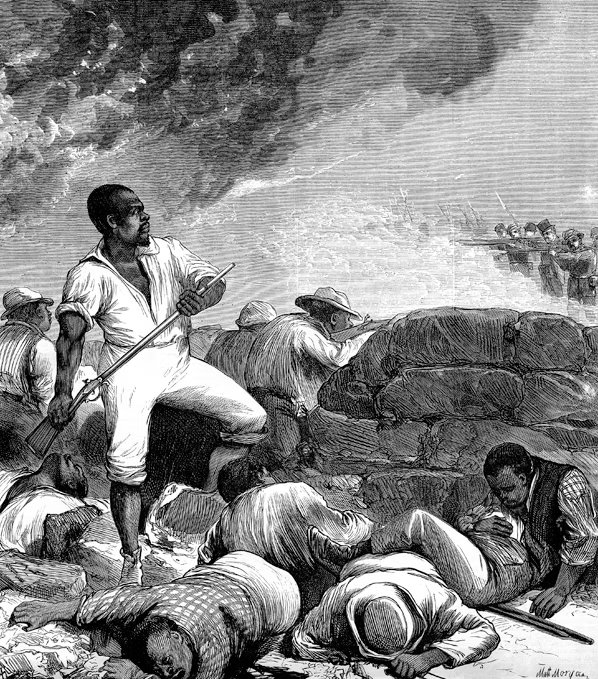
Not that many people know about that Easter Sunday during Reconstruction, when dozens of Black men (some accounts say 150 or more) were slain as they tried to fulfill their official commission to defend the Grant Parish Courthouse from what Supreme Court Justice Samuel Alito recently described as a “white mob.”
Most of those who have heard of the massacre have no idea that as a white militia headed to Colfax, which was then little more than a village, Black men were officially sent there to protect the courthouse and its records. To defend the court, they dug a curved trench on the west side of the building to fight from. After the courthouse was set on fire and the defenders killed, 54 or more of the massacred were buried in that trench. Some men had been shot in the head, their hands tied behind their backs.
Several years later, there was a dispute about where the courthouse should be rebuilt. The local paper described the site’s ground “baptized in blood” and noted that the remains of the dead were “in the way, besides being subjected to indignity and abuse that no one approves.” It suggested that they be moved and buried elsewhere.
That didn’t happen. Grant Parish made the decision to use the same site to rebuild what the newspaper called Grant Parish’s “temple of justice.”
The courthouse was built on hallowed ground, with some covering a portion of the massacre’s burial ground. It remains there today.
Courthouse rebuilt or expanded four times, on the same site

As is customary across the state, the parish owns and maintains the district court building. The basis of my suit is that it is ultimately up to the state to determine what building is suitable for state judicial proceedings.
Over and over, we have missed opportunities to make this right, when the courthouse was replaced or expanded on the same massacre site, in 1882, 1902, 1955 and 1965.
In 1965, workers laying the foundation for the courthouse were shocked to be unearthing bones, according to the Alexandria Town Talk. Bones from the unmarked, unacknowledged mass grave have repeatedly found their way to the surface, by construction crews in 1882, 1899, 1913, 1926 and 1965, as reported in the local press. In 1899, the paper described several boys digging out some of the remain. “True, it was only a negro’s bones,” the paper opined, “but common decency prompts that they be covered out of sight, and humanity dictates that the children should not be allowed to play the role of jackal and grave digger.”
I outlined this troubling history in my draft lawsuit, sent to parish and state officials earlier this year, in March. I named both parties as defendants and sought a declaratory judgment that the district court’s site in Colfax, as chosen by the parish (and by the State for lack of protest), was unsuitable under Louisiana law for use by a state court.
Long before a lawsuit entered the picture, I had wanted to be sure that the state and parish were aware that the current courthouse was holding court on and adjacent to an unmarked mass grave of Black men executed in the largest incidence of Reconstruction racial violence. So I sent the officials an extensive research paper. I followed up repeatedly but never received a response. Only in the face of that silence did I draft the lawsuit.
I am a retired lawyer. For me, a Louisiana state court holding court on a mass grave violates everything I learned in law school. It cuts against the basic legal principles of our democracy, all concepts of fairness, justice and impartiality, and accepted moral and religious beliefs.
I believe that we need to bring dignity and justice to the forgotten and ignored men in the ground at the Grant Parish Courthouse.
Honoring white men from mob but not Black defenders of justice
After I sent out my draft lawsuit, the response was almost immediate. The attorney general’s office set up a meeting between three of its attorneys and me. The Grant Parish DA sent me a letter. I addressed the police jury, the parish’s governing body, during a public session, at their invitation.
At the meeting, I presented historical evidence, including an account from a living eyewitness, establishing that bodies were buried at the courthouse. Bodies were even buried in the area below where the police jury meets today.
I reminded the police jury of the bones found and collected as the foundation for the courthouse was constructed in 1965, the building’s most recent renovation. I reminded them that, for more than 150 years, the graveyard of the Black men killed at the courthouse had not been acknowledged or marked. By contrast, a past police jury had used parish funds to help pay for a 12-foot-tall marble monument in the Colfax Cemetery, which was “erected to the memory of the heroes…who fell in Colfax fighting for white supremacy.” The police jury also paid to remove the remains of one of the three dead white militiamen to the Colfax Cemetery, where the grave was marked by a headstone and protected by a white picket fence.
Although some have suggested that the courthouse should be torn down and the court moved elsewhere, I believe there is another way. With the agreement of the state and parish, the Louisiana Supreme Court should appoint an independent commission of men and women of good will to determine how the burial ground should be identified, marked, protected, maintained as sacred ground, and appropriately memorialized.
I suggested during the presentation that the burial site at the west end of the courthouse be marked, protected, maintained and treated as a sacred place, as required under contemporary moral and religious standards and Louisiana law. To ensure that money would not be an issue, I made a personal financial commitment of up to $100,000 to the police jury to fund original statuary and a proper marker.

Several months after the police jury presentation, I received an email from the DA announcing that a “memorial/garden” area would be built on the east end of the courthouse grounds, away from the area where the burial site was known to be, with construction to begin immediately.
Apparently, the police jury made the decision to build this area at its August meeting. But I could find no evidence that notice had been given to the public that the police jury intended to discuss the massacre and the courthouse burial ground, subjects which would have drawn significant public response. Neither “massacre” or “riot” was mentioned at the meeting.
When I looked, I found an agenda item, item 17: “discuss courthouse beautification project” and minutes for the meeting stating only this:
“Jurors discussed a beautification project for the front of the courthouse to serve as a memorial garden for those who died in the events of April 13, 1873. Parish Manager was authorized to move forward with the project.”
A recording of the meeting provides considerably more context. Though it was described as “just an improvement project,” it came with the approval of the jurors’ legal team, who expressed concern that the parish could lose control of the project if I filed my lawsuit and it was heard in court. The jurors’ attorney characterized the patio as a step in the right direction; jurors described what they were doing as a “beginning point.”
The jurors agreed that a plaque at the memorial would read:
“In memory of those who died in the events of April 13, 1873, in Colfax, Louisiana. Tradition has it that some of whom remain buried in this area to this day.”
The following month, on September 10, the police jury-approved “memorial garden” made the front page of The Chronicle, Grant Parish’s newspaper of record. The accompanying photograph shows three concrete benches and two planters on sidewalk around a square of dirt. There’s a small plaque at the entrance to the square.
“The Memorial Park is substantially completed at the Grant Parish Courthouse,” The Chronicle reported, noting the plaque and the layout. “Benches provide seating for prayers, meditation or just a break from the courthouse.”

A memorial is not a burial ground
The Colfax Riot marker, placed here in 1951, came down in 2021 with the support of Gov. John Bel Edwards, who described it as “false and offensive” and said “it had to come down.” Edwards said that leaving the marker in place sent Black citizens a message: “Stay in your place, because if you don’t, this could happen.”
In 1951. the state placed the historic marker at the courthouse. The text was brief:
“On this site occurred the Colfax Riot in which three white men and 150 negroes were slain. This event on April 13, 1873 marked the end of carpetbag misrule in the South.”
The marker’s text was false, because it sought to justify the racial violence of 1873, which was meant to impose Black submission to white rule. But the men killed were lawfully protecting the courthouse from seizure, were waiting for expected troops from New Orleans to arrive to prevent violence, and were executed after surrender, unarmed and with bound hands.
Bel Edwards’ decision to remove the marker met with opposition and ambivalence in Grant Parish. The police jury held a meeting on the issue where jurors stated that they did not know if the marker was correct or not, but the state could remove it because it belonged to the state.
While the parish’s modest “memorial” now acknowledges that “events” happened in 1873, a patio next to the courthouse does not address the burial ground itself. It does not acknowledge that the courthouse sits on and among the unmarked remains of Black men executed in the Colfax Massacre. It doesn’t honor the ground where they lie as sacred ground entitled to identification, protection and respectful maintenance.
The burial site remains unacknowledged and unmarked. And the state remains silent, even while Black men killed in the name of white supremacy remain beneath and around a state district courthouse where the state of Louisiana promises equal justice. The appearance of justice cannot remain intact in the rest of the state if it remains compromised in Colfax.
It is time for Louisiana to acknowledge and protect the burial ground, to honor the dead and make it right.
Charles R. Moore is a retired Louisiana trial lawyer and former president of the Louisiana Association for Justice and the Louisiana chapter of the American Board of Trial Advocates. He has written and lectured on professionalism, judicial independence and the Colfax Massacre.
Republish This Story
You may republish this story under our republishing guidelines. Please credit the reporter and The Lens, link to the original story, and respect any image restrictions shown below.
Images are included with this story. Republishing remains subject to the rights and credits shown in the article.
Republish This Story
You may republish this story under our republishing guidelines. Please credit the reporter and The Lens, link to the original story, and respect any image restrictions shown below.
Images are included with this story. Republishing remains subject to the rights and credits shown in the article.
License: Creative Commons Attribution-NonCommercial-NoDerivatives 4.0 International